Author Archives: wvk_sm9je57j

EU funds our Space Institute for Crete !

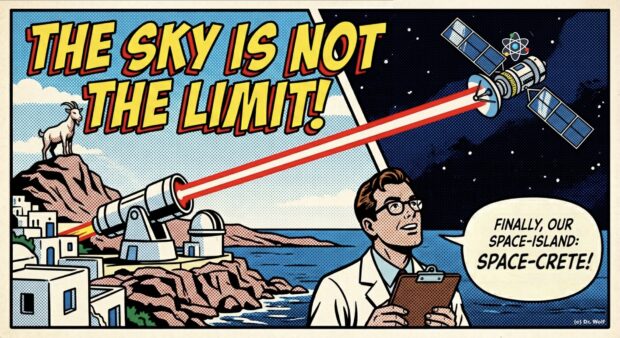
Great News: We have won a 35MEU Teaming Project to create a space-institute on Crete! There are three main participants: The institute of computing (FORTH-ICS) for Space Computing and AI on satellites, the institute of Astrophysics with the Skinakas observatory, and the Institute for Electronics structures and Lasers (IESL) with our Space-Optics-Laboratory.

We will focus on optical (quantum) communications and quantum sensors in space.

Pedro Rivero Antunez

5/2024 – 6/2026 Postdoc on BEC 3


Pedro obtained a 4-year Physics degree in 2016 from the University of Seville (Spain), and a master’s degree in Particle Physics and Astrophysics from the University of Granada (2017), finishing his master thesis entitled «Axial Anomaly in the 5d-Anti-deSitter /4d-Conformal Field Theory (AdS/CFT) correspondence».

His academic journey continued with a PhD focusing on fabrication and characterization of nanostructured ceramics at the Department of Condensed Matter Physics of the University of Seville, where he graduated in June 2023.

In May 2024, he joined the Cretan Matter Waves group as a postdoc researcher for the BEC2 project.

Sofia Botsi: seminar on the BECs on the International Space Station

Our alumni, Sofia Botsi, comes to give us a seminar on the dipole trap for the International Space Station that she is working on (Wednesday 28 February 2024, 12:00 – 13:00, in the lab).

An Optical Dipole Trap for NASA’s Cold Atom Lab

When atoms are cooled down to temperatures within a millionth of a degree of absolute zero, they form exotic quantum states, such as Bose-Einstein Condensates (BECs). While BECs have been routinely produced in terrestrial laboratories, there are increasing efforts in creating and utilizing these macroscopic quantum phenomena in the microgravity environment for fundamental physics investigations. NASA’s Cold Atom Lab (CAL) instrument is a multiuser ultracold atomic physics facility operating onboard the International Space Station that has enabled such space studies of interacting quantum gases since its launch in 2018. In addition to the toolbox of capabilities originally built into CAL, here the compatibility tests for an optical dipole trap development as a potential addition to a future science module resupply are presented. Such an implementation can further enhance the association of weakly-bound diatomic molecules from Rb and K atomic mixtures enabling for ultracold molecule studies. 

Link to a poster on the topic

And a link to the preprint of their related Nature Paper
Logo of CARIOQA-PMP

CARIOQA-PMP has been approved by the EU

Our research proposal “Cold Atom Rubidium Interferometer in Orbit for Quantum Accelerometry – Pathfinder Mission Preparation” (CARIOQA-PMP) has been approve by the EU!

The objective of the CARIOQA-PMP project is to enable Europe to deploy quantum gravimeters/accelerometers in space through a Quantum Pathfinder Mission within the decade.

The future CARIOQA of the EU is to map earth’s gravity field using