8/2025 – today Postdoc on BEC 1
Sourabh did his PhD at the Bhabha Atomic Research Centre, India. He held a Junior and Senior Research Fellow (SRF) at the Raja Ramanna Centre for Advanced Technology, where he worked on TAAP potentials for Rb87.
Cretan Matter Waves Group
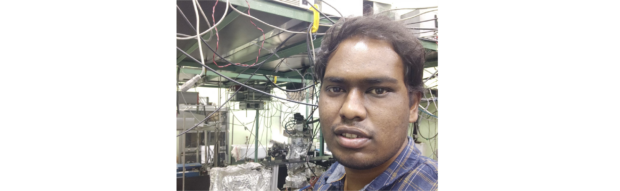
8/2025 – today Postdoc on BEC 1
Sourabh did his PhD at the Bhabha Atomic Research Centre, India. He held a Junior and Senior Research Fellow (SRF) at the Raja Ramanna Centre for Advanced Technology, where he worked on TAAP potentials for Rb87.

5/2024 – 6/2026 Postdoc on BEC 3
Pedro obtained a 4-year Physics degree in 2016 from the University of Seville (Spain), and a master’s degree in Particle Physics and Astrophysics from the University of Granada (2017), finishing his master thesis entitled «Axial Anomaly in the 5d-Anti-deSitter /4d-Conformal Field Theory (AdS/CFT) correspondence».
His academic journey continued with a PhD focusing on fabrication and characterization of nanostructured ceramics at the Department of Condensed Matter Physics of the University of Seville, where he graduated in June 2023.
In May 2024, he joined the Cretan Matter Waves group as a postdoc researcher for the BEC2 project.

Our latest PRL entitled “Atomtronic Matter-Wave Lensing” has just been published in Physical Review Letters.
It has been featured as a synopsis in Physics.APS.org.
Saurabh was the driving force behind this. He believed that this paper could go far and made sure that these great results get the attention it deserves. The effort paid of — thanks and congratulations to the whole team!
Phys. Rev. Lett. 126, 170402 (2021)
S. Pandey, H. Mas, G. Vasilakis, and W. von Klitzing
Our latest PRL entitled “Atomtronic Matter-Wave Lensing” has just been published in Physical Review Letters.
It has been featured as a synopsis in Physics.APS.org.
Abstract
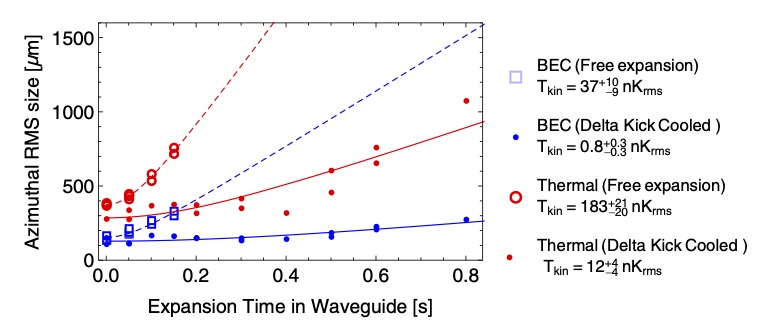
In this Letter, we demonstrate magnetogravitational matter-wave lensing as a novel tool in atom-optics in atomtronic waveguides. We collimate and focus matter waves originating from Bose-Einstein condensates and ultracold thermal atoms in ring-shaped time-averaged adiabatic potentials. We demonstrate “delta-kick cooling” of Bose-Einstein condensates, reducing their expansion energies by a factor of 46 down to 800 pK. The atomtronic waveguide ring has a diameter of less than one millimeter, compared to other state- of-the-art experiments requiring zero gravity or free-flight distances of ten meters and more. This level of control with extremely reduced spatial requirements is an important step toward atomtronic quantum sensors.
A synopsis was published in Physics — https://physics.aps.org/articles/v14/s55

08/2020 – today PhD Student on theoretical Optics
Apostolos has joined us in August 2020 to work on the theory of matterwaves and how to use magnetic lenses and RF-fields to produce coherent lenses and mirrors. The final aim is to create nano-scale matter-wave images
G.A. Sinuco-Leon, H. Mas, S. Pandey, G. Vasilakis, B.M. Garraway, W. von Klitzing
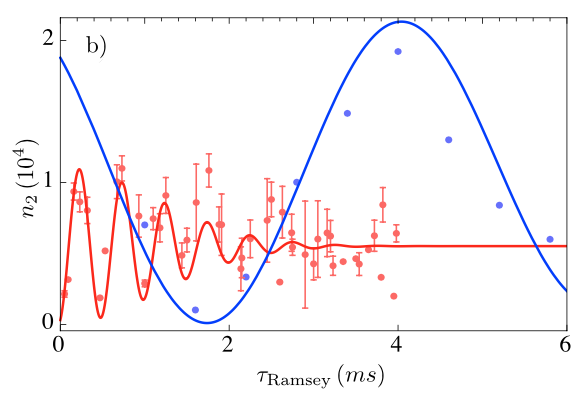
We study the spectral signatures and coherence properties of radiofrequency dressed hyperfine Zeeman sub-levels of 87Rb. Experimentally, we engineer combinations of static and RF magnetic fields to modify the response of the atomic spin states to environmental magnetic field noise. We demonstrate analytically and experimentally the existence of ‘magic’ dressing conditions where decoherence due to electromagnetic field noise is strongly suppressed. Building upon this result, we propose a bi-chromatic dressing configuration that reduces the global sensitivity of the atomic ground states to low-frequency noise, and enables the simultaneous protection of multiple transitions between the two ground hyperfine manifolds of atomic alkali species. Our methods produce protected transitions between any pair of hyperfine sub-levels at arbitrary (low) DC-magnetic fields.
Now on arXive !n

Our latest paper on the spectroscopy between dressed levels of rubidium atoms is out on arXive (pdf).
Abstract:
We study the hyperfine spectrum of atoms of 87Rb dressed by a radio-frequency field, and present experimental results in three different situations: freely falling atoms, atoms trapped in an optical dipole trap and atoms in an adiabatic radio-frequency dressed shell trap. In all cases, we observe several resonant side bands spaced at intervals equal to the dressing frequency, corresponding to transitions enabled by the dressing field. We theoretically explain the main features of the microwave spectrum, using a semi-classical model in the low field limit and the Rotating Wave Approximation. As a proof of concept, we demonstrate how the spectral signal of a dressed atomic ensemble enables an accurate determination of the dressing configuration and the probing microwave field.


The school will be held in Archanes close to Heraklion and the conference close to Chania. We have already assembled a very nice list of speakers… more news soon to come.
More info to come soon at http://www.matterwaveoptics.eu

You must be logged in to post a comment.