Author Archives: wvk_sm9je57j
Prestigious SPIE Scholarship for Deba Pal
Debapriya Pal (on an internship 05/2018-07/2018 working on laser optics) was awarded the prestigious 2018 Optics and Photonics Education Scholarship by the international society for optics and photonics SPIE, the international society for optics and photonics, for his potential contributions to the field of optics, photonics or related field.
Welcome Premjith!
Premjith joins us from the Cochin University of Science and Technology South Kalamassery in Kerala, India to do the research for his master thesis.
An ESA milestone reached.
Our ESA Space-Optics project has reached a major milestone: We have finished the development of a novel beam collimation technique, which works allows us to adjust the waist of the laser beam emitted from a fibre coupler to an arbitrary position simply by maximising the peak intensity of the laser beam at some other position.

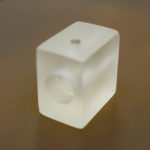
This is a fiber collimator manufactured from the ultra-low expansion material ZERODUR.
In order to make the coupler space-compatible it is manufactured from ultra-low-expansion ceramics (ZERODUR) and has no moving parts.
Quantum Technologies in Space (QTSpace)
We have been appointed the Greek representatives of “Quantum Technologies in Space (QTSpace)”.
The scientific and technological legacy of the 20th century includes milestones such as quantum mechanics and pioneering space missions. Both endeavours have opened new avenues for the furthering of our understanding of Nature, and are true landmarks of modern science. Quantum theory and space science form building blocks of a powerful research framework for exploring the boundaries of modern physicsthrough the unique working conditions offered by experimental tests performed in space.
Long free-fall times enable high-precision tests of general relativity and tests of the equivalence principle for quantum systems.
Harnessing microgravity, high vacuum and low temperature of deep space promises allowing the study of deviations from standard quantum theoryfor high-mass test particles. Space-based experiments of metrology and sensing will push the precision of clocks, mass detectors and transducers towards the engineering of novel quantum technologies.
Matter-wave interferometers using TAAP rings
New Journal of Physics 18 075014 (2016)
P. Navez, S. Pandey, H. Mas, K. Poulios, T. Fernholz, and W. von Klitzing
doi: 10.1088/1367-2630/18/7/075014

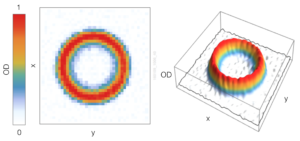
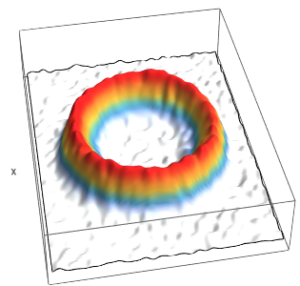
Figure 2. Experimental realisation of a ring-shaped TAAP waveguide. The radius of the ring is R = 570 μm.
Abstract: We present two novel matter-wave Sagnac interferometers based on ring-shaped time-averaged adiabatic potentials, where the atoms are put into a superposition of two different spin states and manipulated independently using elliptically polarized rf-fields. In the first interferometer the atoms are accelerated by spin-state-dependent forces and then travel around the ring in a matter-wave guide. In the second one the atoms are fully trapped during the entire interferometric sequence and are moved around the ring in two spin-state-dependent `buckets’.

Figure 6. Experimental realisation of arbitrary traps. The fitted radius is 440 μm and 450 μm respectively. Note that (a) and (b) are taken with identical experimental conditions and differ only in the state of the atoms. The axis of the circular rf component and the one of the tilted modulation are not orthogonal.
Corrections to the ideal Sagnac phase are investigated for both cases. We experimentally demonstrate the key atom-optical elements of the interferometer such as the independent manipulation of two different spin states in the ring-shaped potentials under identical experimental conditions.
Welcome back Georgos !
Georgos Vasilakis is joining us as a postdoc on BEC1.
Before joining us Vasilis was…
We got beautiful rings in the lab.
Adiabatic Potentials and Atom Lasers
Rom. Rep. Phys. 67 295 (2015). (link)
V. Bolpasi and W. von Klitzing
Abstract:
The brightest atom lasers to date are formed by time-dependent adiabatic potentials from magnetic Ioffe-Pritchard traps. We analyse these potentials based on a harmonic trap in the presence of gravity. We present a detailed analytic model of the trap and determine the flux of the atom laser, which we find to be in good agreement with recent experimental data. We also present a novel method for determining the Rabi frequency of the dressing rf-field.
Design of a dual species atom interferometer for space
| Experimental Astronomy 39:2 167-206 (2015) (link) (arXive) Thilo Schuldt et al.Abstract: Atom interferometers have a multitude of proposed applications in space including precise measurements of the Earth’s gravitational field, in navigation & ranging, and in fundamental physics such as tests of the weak equivalence principle (WEP) and gravitational wave detection. While atom interferometers are realized routinely in ground-based laboratories, current efforts aim at the development of a space compatible design optimized with respect to dimensions, weight, power consumption, mechanical robustness and radiation hardness. In this paper, we present a design of a high-sensitivity differential dual species 85Rb/87Rb atom interferometer for space, including physics package, laser system, electronics and software. The physics package comprises the atom source consisting of dispensers and a 2D magneto- optical trap (MOT), the science chamber with a 3D-MOT, a magnetic trap based on an atom chip and an optical dipole trap (ODT) used for Bose-Einstein condensate (BEC) creation and interferometry, the detection unit, the vascuum system for 10-11 mbar ultra-high vacuum generation, and the high-suppression factor magnetic shielding as well as the thermal control system. The laser system is based on a hybrid approach using fiber-based telecom components and high-power laser diode technology and includes all laser sources for 2D-MOT, 3D-MOT, ODT, interferometry and detection. Manipulation and switching of the laser beams is carried out on an optical bench using Zerodur bonding technology. The instrument consists of 9 units with an overall mass of 221 kg, an average power consumption of 608 W (819 W peak), and a volume of 470 liters which would well fit on a satellite to be launched with a Soyuz rocket, as system studies have shown. |


You must be logged in to post a comment.