Finally, we are back online at BEC.gr. We had some problems with the WP installation, but now … have a look and enjoy!

Cretan Matter Waves Group
Finally, we are back online at BEC.gr. We had some problems with the WP installation, but now … have a look and enjoy!

Just for fun… BECs can also smile: This is a BEC loaded from a dipole trap into a TAAP trap and then propagated for some time. The picture is an absorption image with darker standing for a higher number of atoms.
We are also learning to write 😉 … for example the letter H

An H-shaped thermal cloud of Rb87 atoms (black is more atoms)
And our latest addition … the number 9

A BEC in a ring-accelerator. We first load a BEC into a dipole trap and then into the ring. We then accelerate the BEC to speeds, where the centripetal confinement is not sufficient to keep the BEC in the storage ring. (white=more atoms)
And of course our smiling BEC

A smiling BEC — a reproducible chance event.
(black is more atoms)

We have been appointed the Greek representatives of “Quantum Technologies in Space (QTSpace)”.
The scientific and technological legacy of the 20th century includes milestones such as quantum mechanics and pioneering space missions. Both endeavours have opened new avenues for the furthering of our understanding of Nature, and are true landmarks of modern science. Quantum theory and space science form building blocks of a powerful research framework for exploring the boundaries of modern physicsthrough the unique working conditions offered by experimental tests performed in space.
Long free-fall times enable high-precision tests of general relativity and tests of the equivalence principle for quantum systems.
Harnessing microgravity, high vacuum and low temperature of deep space promises allowing the study of deviations from standard quantum theoryfor high-mass test particles. Space-based experiments of metrology and sensing will push the precision of clocks, mass detectors and transducers towards the engineering of novel quantum technologies.

Georgos Vasilakis is joining us as a postdoc on BEC1.
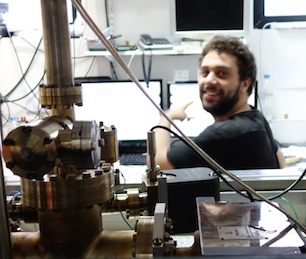
Panagiotis Christodoulou is back for six months working on his publication on the Q-factor and on putting a dipole trap on BEC2.
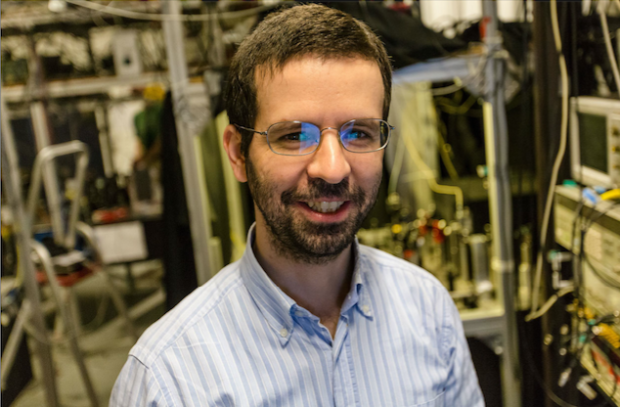
Georgos Vasilakis is joining us for a couple of weeks as a visiting scientist. He is currently a postdoc in the group of Eugene Polzik.

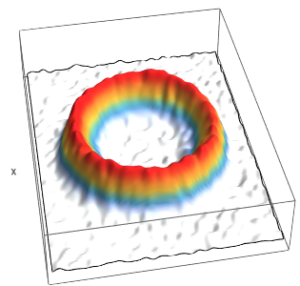
About 10^6 Rb87 atoms in a TAAP ring.

Our Ultra-Bright Atom Laser has selected the article as a New Journal of Physics Highlight of the year 2014.
Phys.org has published a nice semi-popular article about the paper. The New Scientist has also written a rather popularized article about our atom laser.
Note that we have not been given access to any of these articles before publication and are not responsible for its rather imaginative content.


An article in Greek can be found in a number of newspapers, e.g. at Kerdos.gr and in.gr
Article at Kerdos and Article at In.gr
Sigma Live also have made a video interview in Greek about the atom laser.
Igor Lesanovsky, a former postdoc of CMW (2006) now full Professor at University of Nottingham, has won the 2014 Maxwell medal and prize for his outstanding contributions to the theory of control and manipulation of quantum systems, particularly his pioneering studies of highly excited ‘Rydberg’ states in cold atomic gases

Our article on an adjustable Ioffe Pritchard trap has just been voted to to be one of the most important articles of the year 2012 of the Journal of Physics B.
!
You must be logged in to post a comment.