Premjith joins us from the Cochin University of Science and Technology South Kalamassery in Kerala, India to do the research for his master thesis.

Cretan Matter Waves Group
Premjith joins us from the Cochin University of Science and Technology South Kalamassery in Kerala, India to do the research for his master thesis.

The first MOT at the cold atoms and quantum optics group at UNAM.
Congratulations Daniel!!!
Our former postdoc Daniel Sahagun-Sanchez, who is now leading the Laboratory for Cold Atoms and Quantum Optics at UNAM in Mexico, has produced his first Magneto Optics Trap (MOT).

Oleksiy Onishchenko is a PhD student in the group of Florian Schreck in Amsterdam. He visited us to give a talk on their progress towards the construction of a quantum microscope.

Anamika is now doing her master in the theory group of Morgan Mitchell at the ICFO – The Institute of Photonic Sciences.
(Anamika Nair Karunakaran did an internship in our group in summer 2016)

 We are coordinating the COST action on Quantum Technologies using Cold Atoms (AtomQT) has been selected. Thanks to all who contributed to the writing!
Thomas Loppinet, a student from France, is joining us for a short internship

Our proposal to QuantERA is going to the second round… good luck to all partners!

The scientific objective is to investigate Gravitational Waves and other fundamental aspects of gravity as well as the connection between gravitational physics and quantum physics using new quantum sensors, namely, optical atomic clocks and atom interferometers based on ultracold Strontium atoms.
Combining quantum sensing and quantum communication, SAGE is based on recent im- pressive achievements in quantum technologies for optical clocks, atom interferometers, microwave and optical links. This call provides a unique opportunity to investigate in detail the fascinating idea of this ultimate multi-purpose gravity explorer based on all the most advanced achievements in the field.
We consider a multi-satellite configuration with payload/instruments including Strontium optical atomic clocks, Strontium atom interferometers and satellite-to-satellite/satellite- to-Earth laser links.
SAGE main scientific goals are: PRIMARY GOAL:
• Observe Gravitational Waves in new frequency ranges with atomic sensors.
• Search for Dark-Matter
• Measure the Gravitational Red Shift
• Test the Equivalence Principle of General Relativity and search for spin-gravity coupling
• Define an ultraprecise frame of reference for Earth and Space and compare terrestrial clocks
• Investigate quantum correlations and test Bell inequalities for different gravitational potentials and relative velocities
• Use clocks and links between satellites for optical VLBI in Space
Although the technology for such a mission is not mature yet, it takes advantage of devel- opments for the ACES (Atomic Clock Ensemble in Space) mission and the results of ESA studies for SOC (Space Optical Clock), SAI (Space Atom Interferometer), STE-QUEST, GOAT and ongoing national projects in this frame.
Supporting scientists and institutes from ESA member states as well as from USA, China, Japan, Singapore are listed in the final section of the proposal.
G. M. Tino (Lead Proposer) – Universita di Firenze, LENS, INFN, Firenze, Italy
K. Bongs – School of Physics and Astronomy, University of Birmingham, UK
P. Bouyer – Laboratoire Photonique, Numerique et Nanosciences, Bordeaux, France
W. Ertmer – Institute for Quantum Optics, Leibniz Universität Hannover, Germany
L. Iess – Dipartimento di Ingegneria Meccanica e Aerospaziale, Universit`a di Roma, Italy
A. Peters – Humboldt Universität zu Berlin, Germany
E. Rasel – Institute for Quantum Optics, Leibniz Universität Hannover, Germany
A. Roura – Institut für Quantenphysik, Universität Ulm, Germany
C. Salomon – Laboratoire Kastler Brossel, Ecole Normale Superieure, Paris, France
S. Schiller – Institut für Experimentalphysik, Universität Dusseldorf, Germany
W. Schleich – Institut für Quantenphysik, Universität Ulm, Germany
F. Sorrentino – Istituto Nazionale di Fisica Nucleare, Sezione di Genova, Italy
U. Sterr – Physikalisch-Technische Bundesanstalt (PTB), Braunschweig, Germany
F. Vetrano – University of Urbino, Italy
P. Villoresi – Department of Information Engineering, University of Padova, Italy
W. von Klitzing – IESL–FORTH, Crete, Greece
P. Wolf – LNE-SYRTE, CNRS, Observatoire de Paris, France

Our ESA Space-Optics project has reached a major milestone: We have finished the development of a novel beam collimation technique, which works allows us to adjust the waist of the laser beam emitted from a fibre coupler to an arbitrary position simply by maximising the peak intensity of the laser beam at some other position.
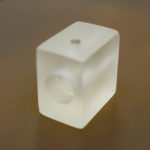
This is a fiber collimator manufactured from the ultra-low expansion material ZERODUR.
In order to make the coupler space-compatible it is manufactured from ultra-low-expansion ceramics (ZERODUR) and has no moving parts.

You must be logged in to post a comment.