Nature Japan reports about our matterwave guides.

Cretan Matter Waves Group
Nature Japan reports about our matterwave guides.
A number of newspapers have reported on our ring-paper in Nature…
For details see (here)





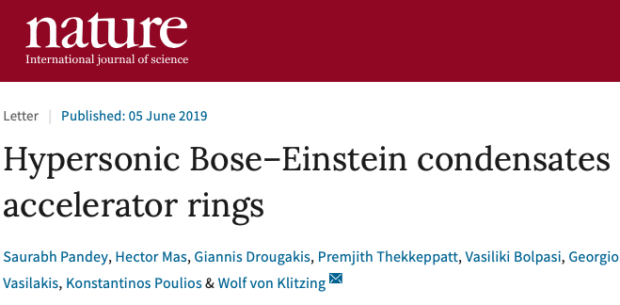
Our article on Hypersonic Bose–Einstein condensates in accelerator rings has just been published in Nature! Congratulations to all the authors.

preprint at arxiv.org (1810.07609) (pdf)
Abstract:
When a Bose-Einstein condensate rotates in a purely harmonic potential with an angular frequency which is close to the trap frequency, its many-body state becomes highly correlated, with the most well-known being the bosonic Laughlin state. To take into account that in a real experiment no trapping potential is ever exactly harmonic, we introduce an additional weak, quartic potential and demonstrate that the Laughlin state is highly sensitive to this extra potential. Our results imply that achieving these states experimentally is essentially impossible, at least for a macroscopic atom number.

Our latest paper on the spectroscopy between dressed levels of rubidium atoms is out on arXive (pdf).
Abstract:
We study the hyperfine spectrum of atoms of 87Rb dressed by a radio-frequency field, and present experimental results in three different situations: freely falling atoms, atoms trapped in an optical dipole trap and atoms in an adiabatic radio-frequency dressed shell trap. In all cases, we observe several resonant side bands spaced at intervals equal to the dressing frequency, corresponding to transitions enabled by the dressing field. We theoretically explain the main features of the microwave spectrum, using a semi-classical model in the low field limit and the Rotating Wave Approximation. As a proof of concept, we demonstrate how the spectral signal of a dressed atomic ensemble enables an accurate determination of the dressing configuration and the probing microwave field.

The BEC and Matterwaves group has won an ATTRACT grant worth 100kEU to develop a novel cavity enhanced microscope (CEMic), which will be capable of detecting minute changes in refractive index or absorption.
Why is there no European Google or Amazon? Why have some of Europe’s hottest start-ups, such as Sweden’s Spotify, moved to Silicon Valley? It is not for lack of great technology or breakthrough science. It is because the mechanism for scaling up promising ventures to global markets is simply not working. Many technologies leading to breakthrough innovations with a big impact on people’s lives stem from fundamental research. ATTRACT is a pioneering initiative bringing together Europe’s fundamental research and industrial communities to lead the next generation of detection and imaging technologies. For the first time, a consortium of big research organisations– that build and operate telescopes, particle accelerators and other capital-intensive scientific instruments – will be explicitly leveraged to capture value and create jobs and growth. For this, ATTRACT will enlist large companies, experienced venture capitalists, and individual investorsalike. The aim is to create an entirely new, European model of Open Innovation that can become an engine for jobs and prosperity for all.

We have been selected for the hot-topic session at ECAMP13 in Florence to speak about “Hypersonic transport of Bose-Einstein condensates in a neutral-atom accelerator ring”.

Hector Mas successfully defended his thesis on Wednesday 6 March 2019 at 12:00, in the 3rd Floor Seminar Room of the Physics Bldg. This is an open presentation in English.
Well done Dr Hector Mas!!!

Our paper on “Simple precision measurements of optical beam sizes” in now in the TOP 10 most downloaded paper of Applied Optics for two months in a row:
We have two new fully funded PhD positions available!
For more information please contact Wolf von Klitzing
You must be logged in to post a comment.